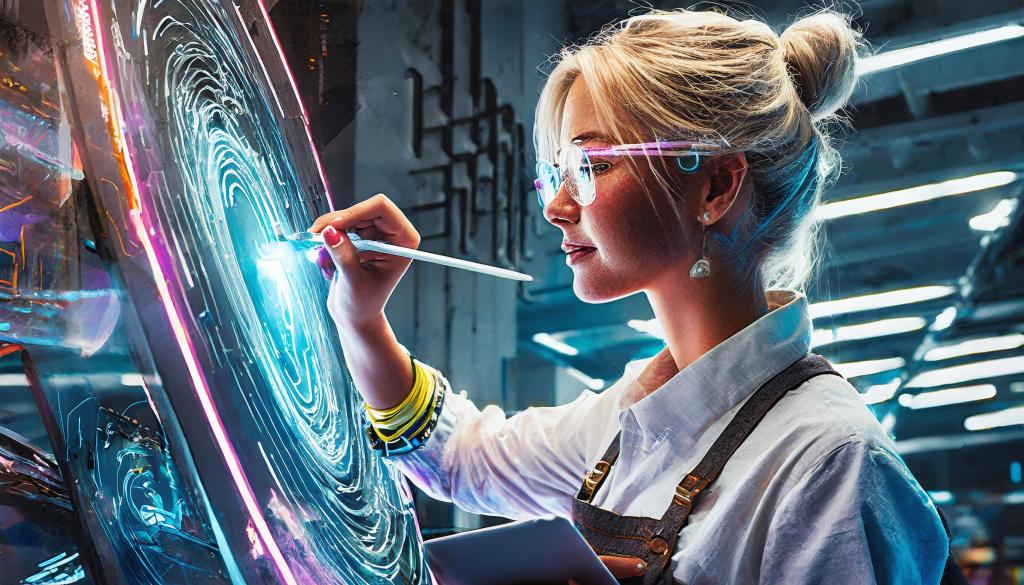
AI-generated art is a rapidly growing field with fascinating possibilities. But how do these models actually work? Let’s delve into the details:
Understanding the Process
At its core, AI art generation involves training a model on a massive dataset of images and text. This dataset helps the model understand the relationships between words and visual concepts. When you provide a text prompt, the model uses this understanding to generate an image that aligns with your description.
Different Techniques, Different Results
Two types of AI models used for art generation are Generative Adversarial Networks and Diffusion Models.
Generative Adversarial Networks (GANs)
Imagine two AI artists, one a forger and the other an art critic. The forger creates increasingly realistic paintings, while the critic tries to discern forgeries from real masterpieces. This competitive dance refines both their abilities, making the forger’s creations more convincing and the critic’s judgment sharper.
That’s essentially how GANs work. One network (the generator) produces images, while the other (the discriminator) evaluates them. Through this ongoing competition, the generator learns to create images that are indistinguishable from real ones, while the discriminator hones its ability to spot fakes. This back-and-forth process results in highly creative and often surreal AI art.
Some examples include:
- Artbreeder: A user-friendly platform that allows you to create images using GANs in a playful and accessible way.
- StyleGAN2: A powerful GAN model known for its ability to generate highly detailed and realistic images.
- BigGAN: A GAN model trained on a massive dataset of images, capable of producing diverse and creative visuals.
Diffusion Models
Diffusion models take a different approach, starting with random noise and gradually transforming it into an image based on the provided text prompt. Imagine a sculptor starting with a formless block of stone and meticulously chipping away to reveal a hidden figure within.
Diffusion models work similarly. They begin with a random pattern of dots or pixels and apply a series of “denoising” steps, guided by the text prompt. Each step brings the image closer to resembling the described concept, like removing unnecessary details and enhancing relevant features. This iterative process results in AI art that often excels at capturing intricate details and producing high-resolution images.
Some examples include:
- DALL-E: A diffusion model from OpenAI, known for its ability to generate photorealistic images based on complex and nuanced text prompts.
- Midjourney: A popular diffusion model used by artists and designers to create unique and dreamlike illustrations.
- Nightcafe Creator: A user-friendly platform that offers access to various diffusion models for generating artistic images.
Both GANs and diffusion models have their strengths and weaknesses, and the choice of which model to use depends on the desired artistic style and outcome.
The Role of the Human Artist
It’s important to remember that AI art models are tools, not replacements for human artists. The artist’s input, through the text prompt and selection of the right model, plays a crucial role in shaping the final outcome. Additionally, AI-generated art often requires post-processing and editing to achieve the desired look and feel.
The Future of AI Art
As AI technology continues to evolve, we can expect even more sophisticated and creative AI art generation models. These models could potentially lead to new art forms and redefine the boundaries of artistic expression.


 Eye4AI Art
Leave a comment